
“Work to live, don’t live to work.” “Find a job you enjoy doing, and you will never have to work a day in your life.” “It’s all about the balance.”
These cliches are often expressed by parents, teachers and advisors to alleviate stress and solicit advice to the younger generation. All Naperville Central students have certainly heard it. We’ve been hassled with strategies and coping mechanisms to manage stress, self-care and prioritizing your mental health over your school or sports career. But these phrases ring hollow when school policies actively push NCHS students toward burnout.
As one example, look at Central’s science course offerings for this school year. As a general biology course, students can take Biology (unweighted) or AP Biology, a rigorous, weighted and fast-paced course. Previously, students could also pick Honors Biology, previously a required prerequisite for moving to AP Biology. As a result, enrollment in AP Biology from Honors students has rapidly increased from last year as students aim to maintain an impressive schedule.
Similarly, Honors Precalculus has been removed from course offerings since the 2024-25 school year, so students must pick between Business Precalculus or drastically increase difficulty by taking AP Precalculus AB or BC. As a result, students who have never taken a weighted math course before feel their options narrowed into choosing an Advanced Placement course in a subject area that is generally perceived as complex and difficult. .
As a sophomore in AP Biology myself, I almost constantly feel confused and behind. With no significant former biology experience, my fellow sophomores and I struggle to keep up with the fast paced curriculum. And as high schoolers, we have so much more to worry about and cannot afford to spend hours reviewing biology notes. Practices, clubs, games, friends, family, jobs. And while nearly every student at our school has these things on their plate and more, it is significantly harder to manage an AP class you don’t feel qualified to take on top of it all.
In fact, it almost seems as if the school is pushing students to take more AP courses, which is not inherently a bad thing. The more students challenge themselves with difficult coursework, the broader their perspective and educational depth becomes. However, there is a glaring trade-off to this decision. Students are overwhelmed, taking weighted and AP courses they feel pressured into – by the school and their peers – and losing themselves in the stress.
By replacing easier Honors courses with AP courses, we are insinuating that we want students to take these courses. And by pushing AP classes on students who may not be ready for such a level change, we are pushing burnout through displacement. Students will inevitably feel inadequate when they struggle in the class, comparing themselves to their peers; a never-ending, detrimental cycle of decreased self worth.
To clarify, this opinion is not pointed at a specific teacher, course or administrator. It is not meant to demean a way of teaching or criticize a teacher’s courseload. I am truly grateful that District 203 and Naperville Central provide a surplus of resources and encourage academic excellence, but it is so important to recognize the growing pattern here: high schoolers are burnt out. They are anxious and scared, at record-high levels. According to the National Library of Medicine, anxiety disorders now affect approximately 14.66% of young people aged 18-25, nearly double the rate from just ten years ago.
But if students are so stressed from their weighted classes, why not just not take them?
The problem is, academic competition has become more ruthless and cutthroat than ever before. College admissions are becoming increasingly selective, and students are not oblivious to this fact. More and more high schoolers are worrying about their post-secondary plans, rushing to improve their transcripts and keep up with their classmates by adding weighted classes.
But as they rush to improve their academic transcripts, they inevitably forget about one important thing: their mental health. American values and capitalistic aspirations have always pushed the value of hard work and even romanticized burnout, but these are kids. Brains have yet to develop, puberty has yet to end, but we are still pushing ourselves to failure all in the hopes of keeping up with the competition.
This looming uncertainty about the future has been well-established and there is little to no way to control it. The fact is, high schoolers will be stressed, and will continue to grow even more anxious. But controlling what we can control as a school community is of the utmost importance for our mental health.
So how can we do that?
To start, Naperville Central can offer more resources to students struggling with their courseload. It’s understandable that administrators want students to challenge themselves. However, not providing the proper tools to ensure these students succeed is just unfair. Central already offers targeted SOAR and lunch support sessions, but by incorporating initiatives such as school-sponsored tutoring and increasing mental health discussions, we can spread a very important message to struggling students: It’s okay to take a break.
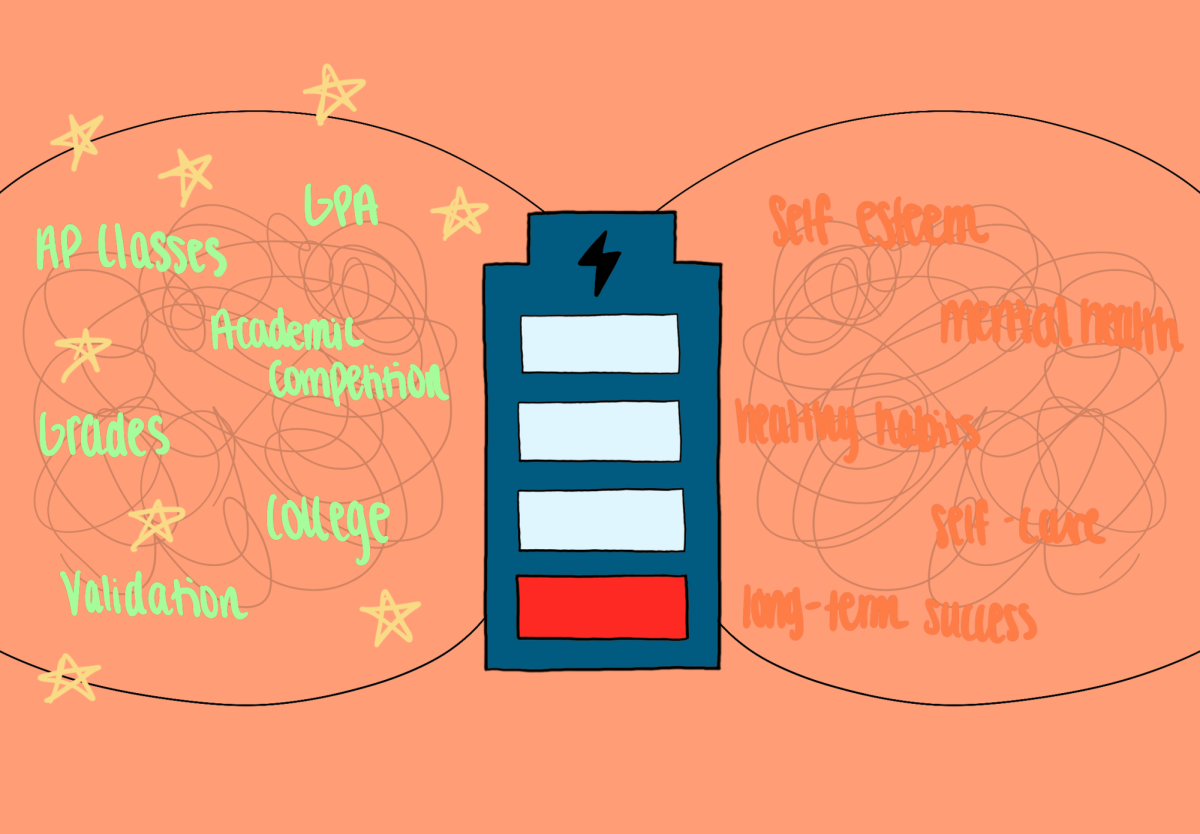
By pushing AP classes onto students, we are further contributing to the competitive academic environment. In a way, we are telling high school students to hyperfixate on academic validation and numerical grades, which is tremendously unhealthy for not only our self esteem but our physical health as well.
As a school community, we need to stress to our students that before the GPA and the Infinite Campus grade comes the basic human responsibility of self-care. Let’s cultivate healthy habits and set priorities straight amongst teenagers (especially as they get ready to enter the adult world), and ensure our long-term success over “going until failure.”