


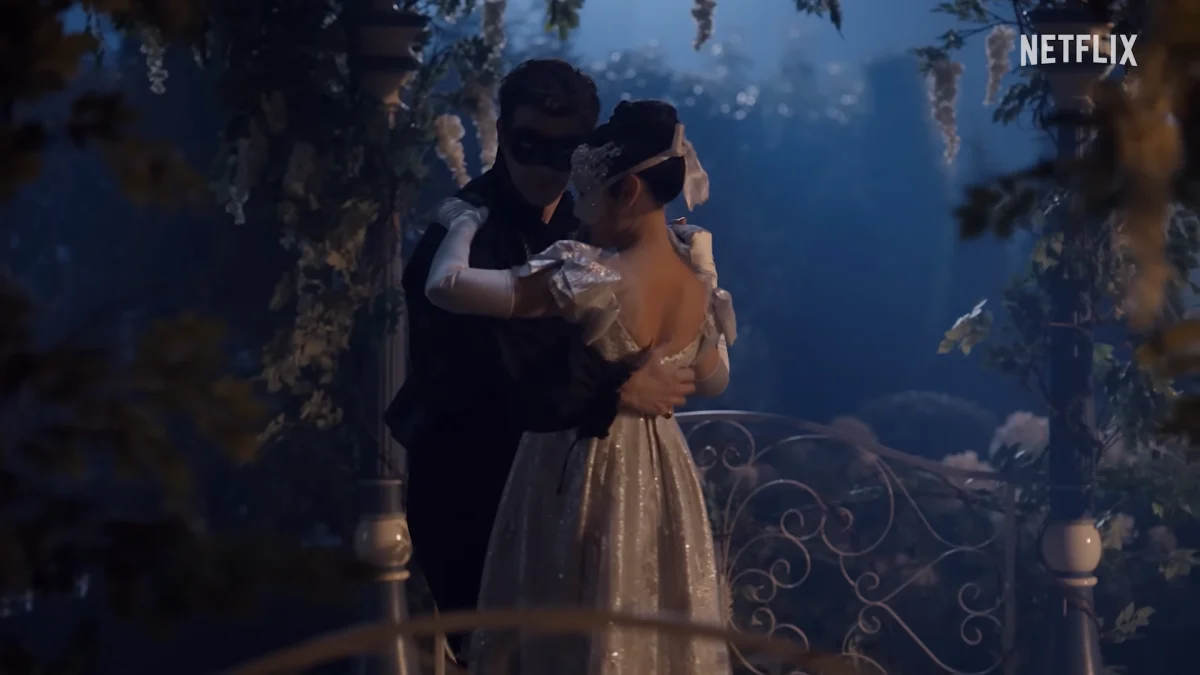
The fourth season of Regency era drama “Bridgerton” was released in two parts, with Part One premiering on Netflix on Jan. 29 and Part two releasing on Feb. 26. This season focused on Benedict Bridgerton’s (Luke Thompson) romance with maid Sophie Baek (Yerin Ha). The storyline was based upon the third book in Julia Quinn’s “Bridgerton” series, entitled “An Offer from a Gentleman.”
Despite the lengthy wait between each season, “Bridgerton” has proven to be a captivating and worthwhile experience for casual watchers and hardcore book fans. As a casual fan myself, I found myself pleasantly surprised with the execution of this season. Considering the lackluster plot in season three, I went into Benedict’s story hoping at the very best for a minor redemption, but I was glad to receive so much more.
“Bridgerton” has always been about celebrating and appreciating love, and this season drove home this theme in the best way yet. Benedict fell for Sophie upon first seeing her at his mother Violet Bridgerton’s masquerade ball, where she is disguised as a lady of the Ton in order to attend the ball. Before he can get her name, however, Sophie realizes that it is midnight and departs him in a Cinderella-esque nature, leaving only her silver glove. As Benedict commences his hunt for the “Lady in the Silver Dress,” he again meets Sophie, this time in her maid clothing.
Benedict originally struggles to realize that a maid and a perceived noble woman could be the same person, a fact very significant in developing this season’s theme. Despite it all, Benedict begins to fall in love with Sophie (the maid). While fans have criticized Benedict for not recognizing Sophie, I find it so poetic that he fell in love with her twice, in every universe. In fact, it is Benedict’s sensitive, loving nature that distinguishes him from other male Bridgerton leads. He proudly communicates his love for Sophie and affirms her constantly through physical touch and powerful words.
Season four was also the first official time we’ve focused on the “Bridgerton” universe through the lens of the lower economic class, the cooks, ladies maids and housekeepers that keep the daily lives of high society members functioning. I truly enjoyed the depictions and developed subplots with members of the lower class such as Footman John, Hazel, Varley, Alfie and Mrs. Wilson. I’ve always considered Bridgerton to be lacking in the sense that it romanticized a Regency era where it was more likely to be a commoner than an overly privileged, wealthy society member, so I’m glad this significant portion of society is finally being recognized.
Previously, viewers have only witnessed romance between members of London’s high society, or the “Ton.” But with Benedict and Sophie, we watched them choose to defy all social rules and customs simply because they could not bear to be without the other. The plot demonstrates a near perfect execution of the star-crossed lovers trope. The stakes felt much steeper than before, making me feel more connected not only to the characters, but the message as well.
“Bridgerton,” despite being set in a socially divisive time period, has always been open to love in its many forms. This is shown not only by the show’s racial diversity and disability representation, but in part by Benedict’s bisexual identity. When he comes out to Sophie, she encourages and accepts him, a portrayal that is refreshing to see in the 21st century.
While the leading couple certainly stole the show, season four of “Bridgerton” did not stray in its sideplots. Among those executed most successfully was Francesca Bridgerton’s (Hannah Dodd) struggle conceiving with newlywed John Kilmartin (Victor Alli). The couple struggled with infertility but eventually accepted their happiness with each other. Shortly after, John passes away in episode seven, leading to perhaps one of the most heartwrenching “Bridgerton” television moments I have experienced. Dodd put on an Emmy-deserving performance, navigating her complex feelings of grief and despair that she has not only lost her husband, but any chance of having children with him.
John’s death also foreplays Francesca’s upcoming season and relationship with his cousin, Michaela. While many Bridgerton fans are at the very least skeptical and most extremely homophobic about the possibility of a leading queer storyline, I am very excited to watch this season in particular. I know it will resonate with the same part of myself and the fanbase that appreciated the message of season four: Love is beautiful, in every way, shape and form.
On that same note, love is not only romantic: it is platonic, a fact “Bridgerton” is well aware of. I truly enjoyed watching the twists and turns of many impactful friendships and sibling relationships, chief among them being the decades-long friendship between Lady Danbury and Queen Charlotte. This season, Lady Danbury asked Charlotte if she could leave London to visit her homeland, and after vehemently denying her, Queen Charlotte relented, the two sharing an emotional goodbye in the season finale during a perfectly placed orchestral cover of “The Night We Met.”
“Bridgerton” has always relied on a fantastical air of romance and magic, utilizing the beautiful set design, dramatic pop orchestral covers (special mention this season: “360” by Charli XCX!) and beautiful costumes to whisk its audiences to Regency era London. But this season, we saw fantasy meet reality. Benedict, formerly noncommittal and free floating, rose to the occasion, committing to a relationship with the woman of his dreams – a woman he could’ve only ever dreamt marrying.
The fantastical love story, paired with its comparability to modern day parallels, made season four of “Bridgerton” not only a swoonworthy romance, but an emotional watch as well. Undeniable chemistry, raw vulnerability and excellent execution has made the latest addition to “Bridgerton” my personal favorite.