


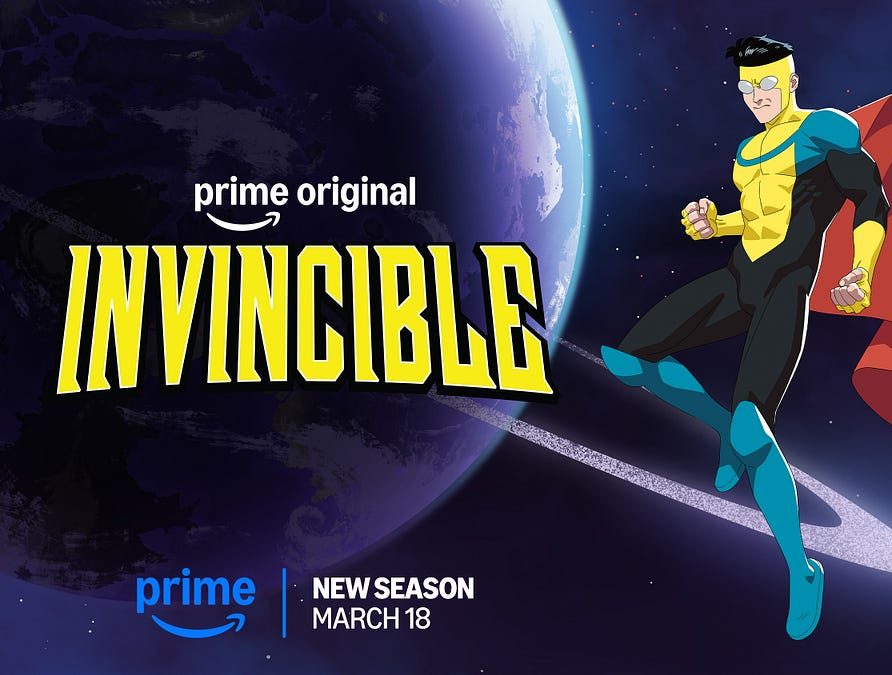
Since its debut on March 25, 2021, Invincible has subverted superhero tropes through the eyes of Mark Grayson, a teenager who inherits his Viltrumite powers from his father, Nolan. What begins as a typical superhero story quickly pivots into a high-stakes epic when Mark and his mom Debbie discover his father isn’t a protector, but a conqueror for the Viltrumite Empire. Over the first few seasons, the show evolves into a conflict as Mark struggles to distance himself from his bloodline while defending Earth from his own people. Nolan has turned to an anti-viltrumite cause, but he’s left a horrible impact on Earth. Now, after Viltrumite’s constant efforts to turn Mark to their cause, the show is diving into the stirring conflict of war.
Season four of Invincible premiered on March 18, with a three-episode release. After the aftermath of the Invincible War and Mark’s brutal fight with Conquest, the Viltrumite soldier, viewers are presented with the mass devastation that followed. Mark himself is shattered, healing from his injuries while suffering from intense self-inflicted guilt over the fallout of Conquest’s arrival.
Episode 1: Invincible returns amid trauma and turmoil:
The first episode also introduces and brings back several threats. One introduction is Dinosaurus, a villain who believes humanity is destroying the planet and that drastic action, including killing many, is necessary to save it. While the concept is promising, the execution was underwhelming. Weak voice acting and disappointing animation made his scenes feel rushed and unimportant.
Numerous new characters, such as a villain capable of draining electricity from power plants and buildings, are stealing power for her planet. One of the most confusing moments in the episode involves the power scaling during this fight. Mark, who is supposedly the strongest character on Earth, lands multiple hits on the villainess, yet she is barely injured. However, when Eve, the superhero known as Atom Eve and Mark’s girlfriend, arrives and lands a single punch, it is enough to knock her out.
The plot inconsistencies are made even more evident when it’s revealed that Eve is getting weaker, her powers beginning to malfunction for a mysterious reason. How is it that Eve is evidently getting weaker, but she can punch harder than the strongest man on the planet?
The largest threat appears when the Sequids, mind-controlling aliens previously defeated by Mark, return. To stop the parasites from spreading, he ultimately kills the original host, an innocent man. This is in stark contrast to his previously established moral compass. Because of his repeated experiences with villains, Mark is gradually becoming more accepting of lethal force, signaling a significant shift in his character.
The season four premiere concludes with Conquest’s awakening in Cecil’s “secure” captivity. Cecil lied to Mark about Conquest being dead, and moments after waking, the soldier escapes and heads straight for Viltrum. The idea of Conquest returning is incredibly exciting; it highlights how misguided Cecil was for not ensuring he was dead.
Despite strong story ideas and meaningful character conflict, the episode is held back by issues that weaken its overall impact. The animation appeared limited, with stiff movement and an overreliance on static dialogue instead of dynamic action, which was only worsened by continuously inconsistent voice acting. The dialogue furthers this negative slope, with the episode disrupted by crude jokes that occasionally interrupt the serious tone.
At the same time, the premiere still succeeds in establishing a world defined by fallouts and guilt, particularly through Mark’s emotional state and the fractured public perception of heroes. However, the same thematic strength is ultimately diluted by scattered antagonistic setups and inconsistent execution that fail to reinforce a central focus, leaving the episode’s intended exploration of heroism and responsibility only partially realized.
Episode 2: Viltrumite revelations raise stakes:
While Earth struggles with the aftermath of recent devastation, Invincible abruptly expands its scope outward, pulling us into the buried history of the Viltrumite Empire. Instead of focusing on superhero conflict, the second episode of the season shifts into origin and ideology. At the same time, Nolan Grayson’s shaky development from villain to reluctant ally continues to reshape the emotional center of the series.
The episode opens with Nolan reflecting on the Scourge Virus, a biological weapon designed to attack Viltrumite DNA. Its release on the Viltrumite homeworld wiped out a massive portion of their population, pushing them to the edge of extinction. The previously perceived as unstoppable conquerors are now nearly destroyed, adding layers of desperation and suggesting Nolan’s mission to conquer Earth was tied to the survival of his species.
Allen and the Coalition of Planets, with Nolan’s help, expand the fight against the Viltrumite Empire beyond Earth, emphasizing a long-term, ongoing resistance. Nolan’s involvement adds moral complexity, as he exists between his past as a Viltrumite enforcer and his current opposition to them, without fully resolving that internal conflict. Meanwhile, the search for powerful weapons like Space Racer’s gun shows the Coalition being pushed toward more extreme measures, suggesting that defeating the Viltrumites may require matching their brutality.
The episode’s most significant development comes from the revelation that the Coalition’s leader, a Viltrumite general who betrayed the empire, is responsible for creating the Scourge Virus that devastated the Viltrumite population. This reframes the conflict into an uncomfortable moral space, where both sides are capable of large-scale atrocities. Nolan’s reaction, reinforced through flashbacks to his family and companions, emphasizes how personal trauma continues to shape his judgment, blurring the line between justified resistance and moral compromise. This further reveals the humanity behind Nolan, highlighting the villain’s true development.
The post-credits scene provides the most exciting moment of the season so far, introducing the formidable Viltrumite leader Thragg, also known as Grant Regent Thragg. As Conquest kneels before him and apologizes for his failure, the scene establishes Thragg as a presence that will likely shape the rest of the season. Seeing this new villain was enthralling, and it made me eager to see how he will affect the story going forward.
Overall, the episode is a strong and more focused entry in Invincible, with engaging character development between Allen the Alien, Nolan Grayson, and the Coalition that deepens both the story and the wider universe, especially through new revelations about the Viltrumites and Nolan’s character. While the animation can still feel inconsistent, and some crude or sexual humor disrupts the tone of serious moments rather than enhancing them, these issues are outweighed by the episode’s narrative strengths and world-building, which culminate in the introduction of the looming threat of Thragg and set up a much larger and more unpredictable conflict for the rest of the season.
Episode 3: Crowded storylines undermine narrative:
As the story expands, Invincible begins conveying multiple threats across Earth and beyond. Mark Grayson, still dealing with emotional instability after recent battles, is pulled into conflicts involving criminals, alien invasions, and shifting power structures. Instead of following a central storyline, the episode splits attention across several threads, risking narrative focus. In the third episode of the season’s premiere, the episode appears to be in fragments of storyline and uneven in execution of visuals.
Much of the episode’s action revolves around Titan and the criminal underworld. Machine Head, an old villain overthrown, begins rebuilding his network of villains while Titan and his family are targeted by Mr. Liu, the villain who can turn his consciousness into a dragon at the cost of paralyzing his real body. Liu’s conflict brought back the same boring threat that many complained about in the previous season. The recycling of plotlines is uninteresting, and I’d prefer to focus on something vital.
After Mr. Liu flees, Mark nearly loses control of Titan, attacking and nearly killing him. He’s stopped by his brother, and knowing Titan only hired his brother because of the threat to his own family, Mark’s loss of control feels out of character. It was odd to see him becoming increasingly violent when Oliver was simply helping Titan. Despite the purposefully off-putting tone, the execution of this scene was lacking. It was out of place and served as a disruption from the story because of its unrealistic plotline. It stumped me why Mark, typically a rational hero, would act this way. However, I appreciated the parallel between Mark and Titan. Titan brutally attacked Magnattack, an assassin sent by Liu to kill his family, in the same fashion as Mark.
The episode then introduces yet another threat when the Flaxans return from their alternate dimension. Although their attack led to Monster Girl and Rex Splode being trapped in that dimension, the conflict itself feels repetitive since the Flaxans have already been defeated thrice in the series previously. It includes a scene where these two ships are having their way with Mark, and the viewer is supposed to believe Mark was strong enough to previously kill Conquest, one of the strongest characters in the show’s universe.
Despite these issues, the episode still contains a few important details, particularly regarding Mark’s emotional instability and the mystery surrounding Eve’s powers. These elements suggest that the season may be building toward larger character conflicts later on.
In the post-credits scene, it is revealed that Eve is pregnant with Mark’s child, indicating why her powers have been malfunctioning throughout the episode.
The fragmented structure of Episode 3 mirrors the instability of the world, but the lack of narrative prioritization weakens its impact. Instead of building tension toward a central conflict, the episode disperses attention across multiple threads, preventing any single storyline from developing enough emotional weight. Mark’s instability and Cecil’s concerns about his aggression are the most thematically relevant elements.
The episode attempts to portray a world unraveling under pressure, but its scattered storytelling undermines that goal. While Mark’s growing instability and Eve’s power issues hint at meaningful long-term developments, they are buried beneath repetitive conflicts and inconsistency. As a result, the episode feels more like an accumulation of disconnected ideas.
Episode 4: Unnecessary detours neglect storyline:
After the intensity of recent episodes, “Invincible” takes a 180-degree detour into the underworld and the return of Damian Darkblood, the demon detective from season one. The episode, released on March 25, 2026, intentionally lowers the stakes, shifting away from a slow moral collapse in favor of a smaller, episodic conflict. But in doing so, the episode loses momentum.
Damian Darkblood finds himself caught in a conflict involving Volcanika, a threat tied to the underworld, only to end up recruiting a confused Mark Grayson instead. Mark is initially reluctant to help, given that demons are generally seen as evil by humans, but he ultimately agrees after learning that Volcanikka plans to ascend to the surface world and massacre humans. While the interactions between Mark and Damian provide some brief humor, they don’t meaningfully contribute to the larger season arc. Instead, the episode’s shift into an underworld-focused storyline feels jarring, pulling the narrative away from the more grounded and serious direction the series has been building toward.
Mark’s characterization is inconsistent here. While the episode tries to present a lighter version of him, it doesn’t work. Given the adversity he’s experienced and his past behavior, the sudden tonal shift makes his behavior feel rather unrealistic. It’s refreshing to see him act “better”, but instead of feeling like a natural break, it comes across as the show disregarding his recent trauma.
One of the main conflicts with Mark is his decision whether to kill or spare villains. It’s shown through stirred disputes where he struggles to decide. But here, Mark blows Volcanika’s head clean off without a second thought, betraying the previous character trait. If this was meant to be character development, its execution was performed poorly, and only confuses the audience.
With the season building toward much larger conflicts, taking time for what is essentially a side plot with Darkblood makes the pacing feel uneven. It doesn’t develop ongoing arcs in a meaningful way, and by the end, it feels like very little has actually been accomplished.
The final scene is the finest of the episode. After the chaos of the underworld and previous episodes, Mark and Eve have a more grounded moment. Mark relaxes with her, and both of them have a short conversation. Although they’ve discussed it in previous episodes, this one feels more necessary. The voice acting was powerful, showcasing tension and stress in his voice, but it fades as he goes on.
However, the moment is short-lived. As Eve is just about to tell Mark about her pregnancy, she is stopped by a sudden sight of Nolan and Allen in the distance, preparing for the future. This ending does a lot of heavy lifting. It immediately pulls the story back on track to the looming Viltrumite war and sets up what’s to come, especially with Nolan (who Mark believed was dead) returning to recruit him.
While episode four attempts to provide a lighter, more focused break from the season’s intensity, it comes at the cost of cohesion. There are a few entertaining and refreshing moments, but the episode ultimately feels disconnected and low-impact. It’s not terrible, but it’s easily one of the weaker entries this season, serving more as filler than a meaningful part of the story.